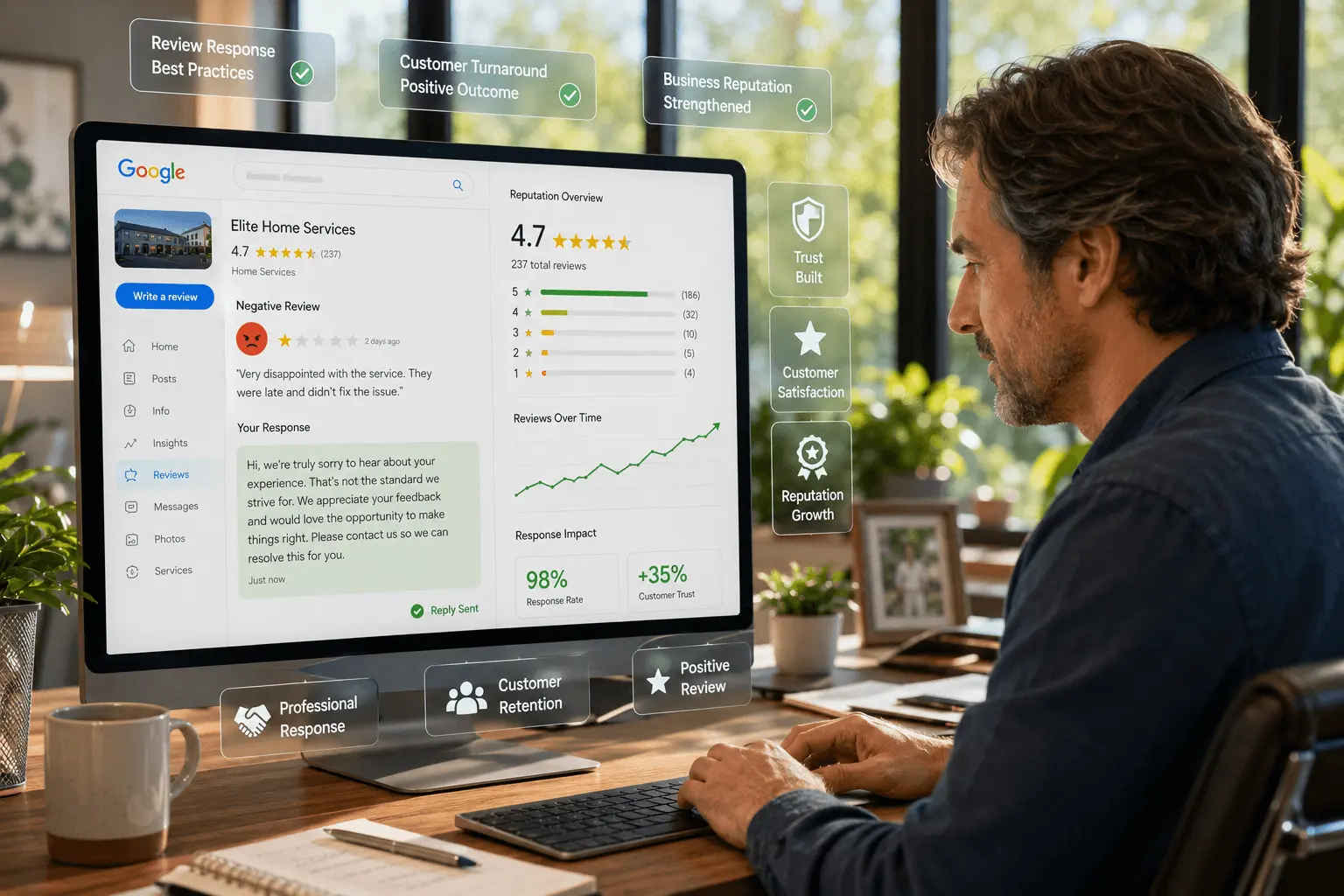
A restaurant owner in Denver showed me a Google review response that had cost him more business than the original one-star review ever could have. A customer left a review claiming the service was slow and the food arrived cold. It had three likes and would have been buried under 140 positive reviews within a week. Instead, the owner typed a 280-word response accusing the customer of lying, suggesting she had confused his restaurant with a competitor, and ending with a pointed remark about customers who complain online instead of speaking to management.
That response got 47 likes. Not because people agreed with him. Because they found it fascinating in the same way a traffic accident is fascinating. Food bloggers screenshotted it. A local news outlet ran a piece titled "Denver Restaurant Owner Destroys His Business in a Single Google Review Response." His three-year rating average of 4.6 stars dropped to 4.1 within a month as people who had never visited his restaurant left reviews in response to the controversy.
One bad review. One worse response. A reputational crisis that took 18 months to fully recover from.
If you want expert help with this, explore our Review Management — we work with service businesses across the UK, Dubai, and UAE.
The maddening thing is that the original review was not even that damaging. A single complaint about slow service in a restaurant with 140 reviews would have been read by most potential customers as an outlier. What made it catastrophic was the response. And what made the response catastrophic was that the owner did what most business owners want to do when they feel unfairly criticized: he fought back. This guide explains why that instinct is always wrong, what the data shows about how potential customers actually read review responses, and exactly what to write instead.
Why Negative Reviews Are Not the Threat You Think They Are
Here is the counterintuitive truth about negative reviews that most local business owners never fully internalize: a handful of negative reviews among many positive ones does not hurt your business nearly as much as you think it does. In fact, research from Northwestern University's Spiegel Research Center found that a perfect five-star average can actually reduce purchase intent because consumers become skeptical that the reviews are curated or fake. Products and businesses with ratings between 4.2 and 4.5 stars consistently outperform five-star averages in conversion rate studies.
Potential customers reading your reviews are not looking for perfection. They are looking for patterns. One review complaining about slow service in an otherwise glowing profile reads as an outlier, one difficult customer in a thousand satisfied ones. Five reviews over six months all mentioning slow service reads as a systemic problem. The difference is not the presence of negative feedback. It is the pattern the feedback reveals.
What potential customers pay far more attention to than the negative review itself is how you respond to it. A 2023 BrightLocal study found that 89% of consumers read business responses to reviews and 57% said they would be more likely to visit a business that responds professionally to negative feedback than one that does not respond at all. Your response to a negative review is public communication to every future customer who reads your profile. It is not a private conversation with a dissatisfied customer. It is your most visible demonstration of how your business handles problems.
That reframe changes everything about how you should approach negative reviews. The goal of your response is not to defend yourself, correct the record, or win an argument. The goal is to demonstrate to the hundreds of future customers who will read that exchange that your business takes concerns seriously, handles conflict with professionalism, and genuinely cares about customer experience.
The Five Principles That Every Good Negative Review Response Follows
Principle One: Respond Within 24 to 48 Hours
Response speed signals how seriously you take customer feedback. A review that sits without a response for two weeks tells potential customers that you either do not monitor your online reputation or do not care about it. Both interpretations are damaging. Set up Google Business Profile notifications so you receive an alert every time a new review is posted. Aim to respond to every negative review within 24 hours and every positive review within 48 hours. Consistency in response time is itself a trust signal that communicates active, attentive business management.
Principle Two: Acknowledge the Experience Without Defending the Business
The single most important shift in mindset for writing good negative review responses is separating acknowledgment from agreement. You do not need to agree that the customer's experience was your fault in order to acknowledge that they had a bad experience. These are two different things and conflating them is what causes business owners to write defensive responses.
"I'm sorry you felt the service was slow" is not an acknowledgment. It subtly disputes the reviewer's experience by framing it as a feeling rather than a fact. "Thank you for sharing this with us. What you experienced does not reflect the standard we hold ourselves to and I'm genuinely sorry your visit fell short" is a true acknowledgment. It validates the experience without admitting specific wrongdoing in a way that could be legally problematic, and it sets a standard that reassures future readers.
Principle Three: Take the Conversation Offline Immediately
Your public response to a negative review should be no more than three to five sentences. Anything longer becomes a public argument regardless of your tone. After acknowledging the experience briefly, direct the reviewer to contact you directly through a phone number or email address to discuss the situation further. This serves two purposes. It signals to future readers that you take complaints seriously enough to resolve them personally. It also removes the continued back-and-forth from the public forum where every exchange becomes part of your visible reputation.
Principle Four: Never Include Identifying Details About the Transaction
This is a legal and privacy consideration that most business owners do not think about. Responding to a negative review with details about the specific transaction, what the customer ordered, what they paid, when they visited, or what was said during their visit, can violate customer privacy expectations and in some industries creates legal exposure. A medical practice that responds to a negative review mentioning that the patient was late to their appointment has just disclosed information about a patient's appointment status in a public forum. Keep responses general enough that they could apply to any dissatisfied customer.
Principle Five: End on a Forward-Looking Note
Close every negative review response with a brief statement about what you hope for next. Something as simple as "We would love the opportunity to make this right and hope to see you again" accomplishes two things simultaneously. It signals genuine care for the customer relationship to the reviewer. It signals to future readers that this business views service recovery as a priority rather than a PR exercise. That forward-looking close is also the element most likely to influence the reviewer to update or remove their original review after you have resolved the issue offline.
The Five Types of Negative Reviews and How to Handle Each One Differently
Not all negative reviews call for the same response strategy. The tone, length, and specific content of your response should adapt to what kind of review you are dealing with. Treating every negative review identically produces responses that feel formulaic, which reduces their effectiveness with the readers you are trying to reassure.
The Legitimate Complaint
This is the most common type and the one where a genuine, warm response does the most good. The customer had a real problem with your product or service and described it honestly. They are not being dramatic. They are not lying. Something went wrong and they want it acknowledged.
Your response should thank them for the feedback, acknowledge the specific issue they raised without excessive detail, apologize sincerely, and invite them to contact you directly to make it right. Do not make excuses. Do not explain why the problem happened. Do not promise that it will never happen again (you cannot guarantee that). Just acknowledge, apologize, and invite resolution. Future readers watching how you handle this are making a judgment about your character as a business. Respond accordingly.
The Exaggerated or Partially Inaccurate Review
Some negative reviews contain elements that are exaggerated or factually inaccurate. A customer claims they waited 90 minutes for food when your records show their order came out in 35 minutes. A client says you never returned their calls when you have three call logs showing outreach. This situation is where business owners most frequently make damaging response mistakes, because the temptation to correct the record publicly is almost overwhelming.
Resist it. Responding publicly to dispute specific facts in a customer review escalates the exchange, signals defensiveness to future readers, and rarely convinces the original reviewer to change their account. Instead, acknowledge that their experience clearly did not meet expectations, express genuine regret that things did not go well, and invite them to contact you directly where you can review the specifics together. This response is honest without being confrontational and leaves future readers with a much better impression than a point-by-point rebuttal would.
The Fake or Competitor Review
Fake reviews from people who never visited your business, often posted by competitors or disgruntled former employees, are a real and growing problem. If you receive a review from someone you have no record of as a customer and the review contains details that do not match your business at all, it is likely fake.
Your first step is to flag the review for removal through Google Business Profile by clicking the three-dot menu on the review and selecting Report review. Document your reasoning for why the review appears fake. Google investigates flagged reviews manually, which takes days to weeks and does not always result in removal. While you wait, respond publicly using language that subtly signals to readers that something is off without making a direct accusation you cannot prove. Something like: "We take all feedback seriously and have reviewed our records thoroughly. We do not have any record of this visit in our system. We would welcome the chance to connect directly at [phone/email] to understand what happened." That response is honest, professional, and plants a reasonable doubt in every future reader's mind without opening a public dispute.
The Emotionally Charged or Aggressive Review
Some negative reviews are written in a state of genuine anger, contain inflammatory language, or make serious accusations about your business or staff. These are the reviews that feel most personal and that trigger the strongest defensive responses from business owners. They require the most careful handling for exactly that reason.
Write your response draft and then wait 24 hours before posting it. Read it again cold. Ask yourself honestly whether a stranger reading both the review and your response would come away thinking better or worse of your business. If the response still feels defensive, justifying, or emotionally reactive in any way, rewrite it. The goal with angry reviews is to be the calmest, most professional voice in the exchange. Future customers consistently give more credit to the business that responds with grace under provocation than to the reviewer who vented.
The Review That Contains a Genuine Service Failure
Occasionally a negative review describes something that genuinely should not have happened and reflects a systemic problem in your business rather than an isolated incident. An employee was rude. A product arrived damaged and nobody followed up. A service was performed incorrectly and the customer was left worse off than before. These reviews require your most careful and most human response because they involve real harm to a real person.
Respond with genuine accountability. Do not hedge, minimize, or pivot to what usually happens in your business. Acknowledge specifically what went wrong to the extent you can without identifying the customer or violating privacy. Express genuine regret in the clearest possible language. Invite them to contact you directly and be specific about what you intend to do to make it right. Then actually follow through on whatever you promise in that response. Future customers who read an earnest accountability response followed by an updated review from the original poster saying the business made things right receive one of the strongest possible trust signals available.
Negative Review Response Approaches: What Works vs What Backfires
| Situation | Response That Backfires | Response That Builds Trust |
|---|---|---|
| Legitimate service complaint | Explain why it happened and defend your process | Acknowledge, apologize briefly, invite offline resolution |
| Exaggerated or inaccurate review | Dispute specific facts publicly with evidence | Acknowledge disappointment, invite direct contact to review specifics |
| Fake or competitor review | Accuse them publicly of lying or being a competitor | Note no record of visit exists, invite direct contact professionally |
| Aggressive or angry review | Match their energy or correct their tone | Respond calmly and professionally, do not engage with the anger |
| Genuine service failure | Minimize or deflect responsibility | Accountable, specific, and direct about making it right |
| Review mentioning a specific employee | Defend the employee publicly or name them | Address the experience without identifying or defending staff |
| Multiple reviews on the same issue | Copy-paste identical responses | Address pattern publicly, explain what you are changing |
The Response Formula That Works Across Almost Every Scenario
After writing and refining hundreds of negative review responses across client accounts in a wide range of industries, a consistent structure emerges that performs well across nearly every type of negative review. It is not a rigid template. It is a framework you adapt to the specific situation. But the structural logic stays consistent.
Sentence one: use the reviewer's name if provided and thank them for taking the time to share their experience. Not a hollow thank you but a genuine acknowledgment that feedback requires effort from the customer. Sentence two: acknowledge the specific experience they described in plain language without disputing it, minimizing it, or explaining it away. Sentence three: apologize sincerely and briefly. One sentence. Not three sentences of excessive apology that reads as performative. Sentence four: provide your direct contact information and invite them to reach out. Sentence five: express your hope to resolve the situation and, where appropriate, to welcome them back.
That five-sentence structure covers every element a potential customer needs to see in your response: acknowledgment, accountability, a path to resolution, and a forward-looking close. It takes under two minutes to write once you are familiar with the framework and reads as genuinely human rather than formulaic when the specific details of the acknowledgment are tailored to each review.
How Negative Review Responses Affect Your Local SEO Rankings
Most guides about negative reviews focus entirely on reputation management and ignore the SEO dimension. Responding to reviews, both positive and negative, is a measurable local SEO signal that influences your Google Business Profile's prominence score and your map pack ranking position.
Google's own documentation states that responding to reviews shows that you value your customers and the feedback they leave about your business. Beyond the stated policy guidance, BrightLocal's Local SEO ranking factor studies consistently identify review response rate as a positive ranking signal, particularly in competitive local markets where other signals are relatively equal between businesses. A business that responds to 95% of its reviews within 48 hours is demonstrating active profile management that Google's local algorithm rewards.
The keywords that appear naturally in your review responses also contribute modest relevance signals. When you respond to a review mentioning a specific service and your response naturally includes that service name and your location, you are adding keyword-rich content to your GBP profile without keyword stuffing. This is not a primary ranking factor but it is a consistent marginal benefit that accumulates over hundreds of responses across years of review management.
Perhaps most importantly, actively managing your review responses tends to increase review volume over time. Customers who see that a business responds thoughtfully to all reviews are more likely to leave reviews themselves because they believe their feedback will be read and acknowledged. Higher review volume with strong recency is one of the most reliably documented map pack ranking signals available to local businesses.
Building a Review Response System That Does Not Consume Your Day
The biggest practical obstacle to consistent review management for most small business owners is time. Checking Google Business Profile daily, reading new reviews, and writing personalized responses feels like one more task competing for attention in an already full day. The solution is not better discipline. It is a system that makes the process fast and consistent without requiring daily manual effort.
- Enable GBP notifications in your Google Business Profile settings so every new review triggers an email or phone notification immediately
- Set a calendar reminder for every Tuesday and Thursday morning to check for any reviews the notification system may have missed and to review draft responses
- Keep a private document with two to three example responses for each common review type as starting points for personalization, not copy-paste templates
- Assign review response ownership to one specific person in your business rather than leaving it as a shared responsibility that nobody prioritizes
- Set a hard rule that no negative review response goes live without a 24-hour cooling-off period if the review feels personal or unfair
- Track your average response time monthly using GBP Insights and aim to keep it under 48 hours for negative reviews and under 72 hours for positive ones
This system takes about 20 to 30 minutes per week to maintain once the initial setup is complete. That 20 minutes protects one of your most valuable business assets: the public reputation that every potential customer evaluates before deciding whether to call you, book with you, or walk through your door.
Frequently Asked Questions About Responding to Negative Google Reviews
Respond to every negative review without exception. The reviews you skip are the ones future customers notice most. A profile with 12 negative reviews where 10 have thoughtful responses and 2 have no response at all makes potential customers wonder what those 2 reviews said that was too difficult to address. Responding to every review, even brief one-sentence responses to minor complaints, signals consistent and attentive business management. The effort required to respond to a two-star review is similar whether the review is detailed or brief. Make it a non-negotiable policy and apply it without exception.
Yes and you should, but how you ask matters enormously. After resolving the issue offline through a phone call or in-person conversation, you can mention at the end of that conversation that you would genuinely appreciate it if they had a chance to update their review to reflect the resolution. Do not make the request feel transactional or conditional on the resolution you just provided. Do not send a formal email requesting review removal that feels like a legal notice. A casual, genuine mention at the end of a productive resolution conversation is appropriate and frequently results in the reviewer either updating their review or removing it entirely. Google allows reviewers to edit or delete their own reviews at any time and many choose to do so after a business has handled their complaint well.
If a review contains demonstrably false statements of fact rather than subjective opinions, and those statements could cause measurable harm to your business reputation, you may have legal recourse beyond Google's review removal process. Consult a business attorney who handles defamation matters before taking any public action. In your public response, do not engage with the specific false claims directly. State clearly that your records do not reflect what was described, invite direct contact, and keep the tone professional. Publicly disputing specific facts in a review response rarely helps your reputation even when you are clearly right. Legal remedies, when appropriate, are pursued offline through proper channels.
No, and attempting to prevent or hide legitimate negative reviews violates Google's review policies and can result in your GBP being suspended. Google does not allow businesses to filter, curate, or selectively display reviews. The only legitimate way to minimize the impact of negative reviews is to generate a high volume of genuine positive reviews through excellent service and a systematic review request process, which naturally dilutes the proportion of negative reviews in your overall rating. A business with 8 negative reviews among 200 total reviews has a very different perception problem than a business with 8 negative reviews among 22 total reviews. Volume is your legitimate defense.
Three to five sentences is the optimal length for most negative review responses. Under three sentences can feel dismissive of the reviewer's concern. Over five sentences risks turning the response into a public argument or an excessive apology that reads as performative. The five-sentence framework covered in this guide consistently hits the right balance: enough length to demonstrate genuine engagement, short enough to avoid the defensiveness that comes with length. If you find your draft consistently running longer than five sentences, identify which sentences are justifying or explaining rather than acknowledging and apologizing, and remove them. Explanation is the enemy of a good negative review response.
The same core principles apply across all review platforms: respond promptly, acknowledge the experience, apologize briefly, take the conversation offline, and close on a forward-looking note. Platform-specific differences are mostly structural. Yelp's community guidelines discourage certain types of responses and their moderation is more active than Google's. TripAdvisor responses have a longer character limit and slightly more context-heavy responses perform better with their specific audience. Facebook reviews integrate with social media conversations and benefit from a slightly warmer, more social tone than the more formal Google response style. The fundamental goal, demonstrating to future customers that your business handles criticism with grace and professionalism, is identical across every platform.
Multiple negative reviews from what appears to be the same person using different accounts violates Google's review policies. Flag each review individually through the Report review function, selecting the reason that the reviewer has a conflict of interest or that the review does not represent a genuine customer experience. Document the similarities between the reviews that suggest a single source. Google's review moderation team investigates patterns of suspicious review activity and has tools to identify reviews from the same device or IP address. In your public responses to the suspected duplicate reviews, use identical or near-identical language so that anyone reading multiple reviews sees a consistent, professional business response rather than evidence that the reviews are getting under your skin.
The Response Is Always More Visible Than the Review
The Denver restaurant owner eventually recovered his reputation. It took 18 months of genuinely excellent service, a systematic review generation campaign that rebuilt his positive review volume, and a complete overhaul of how he responded to criticism online. He now has a standing rule in his business: no one responds to a negative review without his approval, and his approval process includes a mandatory 24-hour waiting period and a read-aloud test where the response is read out loud to a staff member who was not involved in the incident.
That process has produced zero viral response disasters since he implemented it. More importantly, several of the negative reviews he has responded to since have been updated by the original reviewers after he resolved their concerns offline. Two of those updated reviews now describe how professionally the restaurant handled the complaint, which is genuinely more persuasive to potential customers than a five-star review with no context.
Your response to a negative review is always more visible than the review itself, because far more people read responses than write reviews. Every response you post is a demonstration of your values, your professionalism, and your genuine commitment to customer experience. Done well, a response to a negative review can convert a skeptical reader into a customer more effectively than any marketing campaign you could run. Done badly, it can achieve what the Denver restaurant owner achieved: turning a minor problem into a reputation crisis that takes years to repair.
What is the most challenging type of negative review your business faces? Drop it in the comments and I will write you a specific response framework tailored to your industry and situation.
Want Results Like This for Your Business?
Get a free Local SEO audit — we will show you exactly what is holding your rankings back and the fastest path to the Google map pack.
Talk to a Local SEO Specialist →