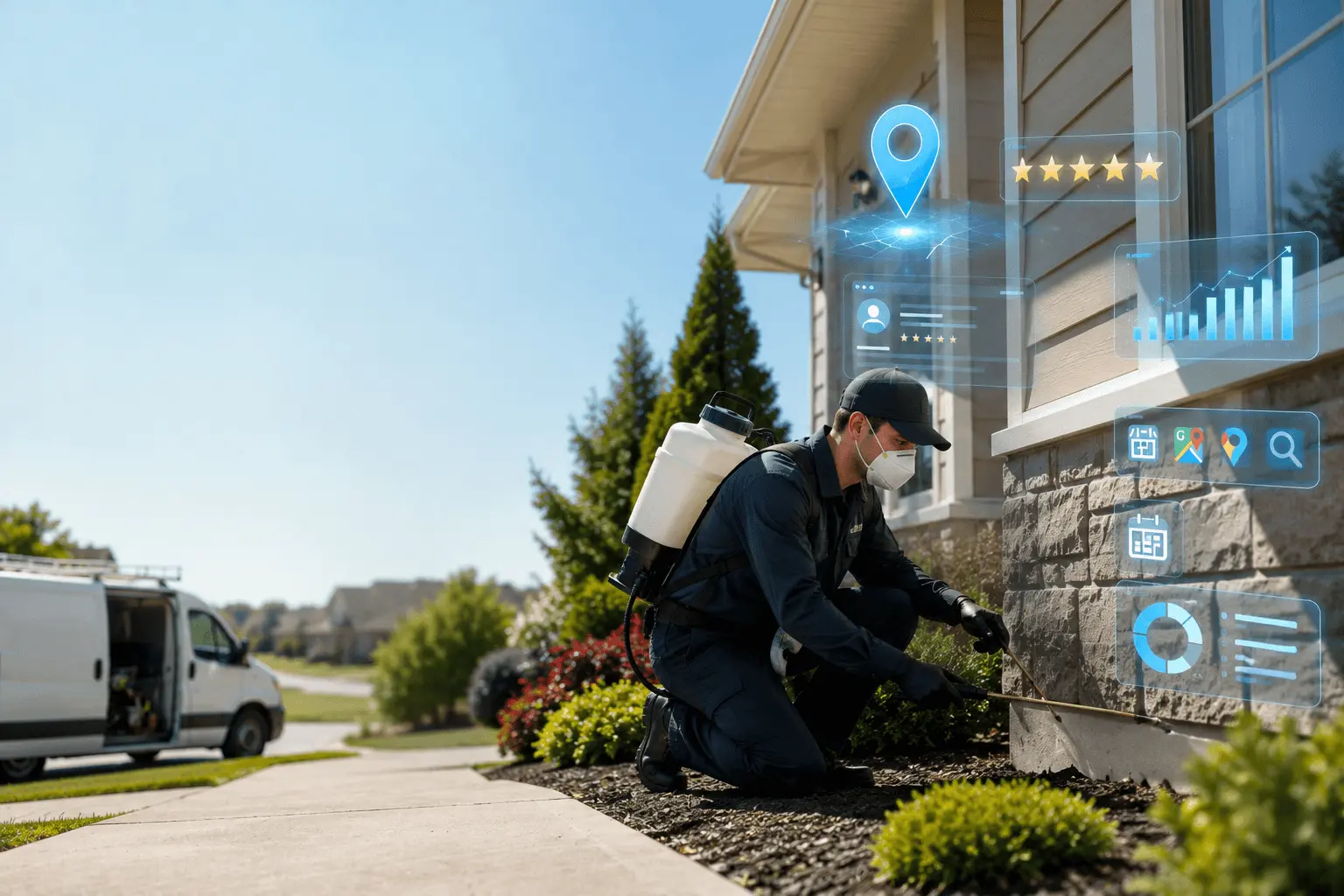
Tony had been running his pest control company in Birmingham for nine years. He had built a solid reputation, held all the relevant BPCA certifications, and served a mix of residential and commercial clients across the West Midlands. His business had grown almost entirely through referrals and repeat contracts. Then in spring 2024, a new competitor launched in his area with a slick website, a fully optimised Google Business Profile, and a Google Ads campaign. Within four months that competitor was ranking above Tony for every keyword that mattered.
Tony called me in frustration. His company had treated three times as many properties, had better accreditations, and had never once failed a follow-up inspection. But when a homeowner in Solihull discovered mice in their kitchen at 9pm on a Tuesday and grabbed their phone to search for pest control, Tony's company was not what they found. The new competitor was.
Eight months after building a proper local SEO strategy, Tony's company ranked first in the local pack for his primary service and location keywords. His inbound call volume from Google had tripled. His emergency call-out bookings, the most lucrative jobs, had increased by 140% because emergency searches convert directly into phone calls and his profile was what appeared when those searches happened.
If you want expert help with this, explore our Local SEO Services — we work with service businesses across the UK, Dubai, and UAE.
Pest control local SEO has characteristics that make it both urgent and highly winnable for established operators. The searches are emergency-driven, the intent is immediate, and the competitive landscape is still dominated by companies that rely on referrals and have not invested in their online presence. This guide covers everything a pest control company needs to build local search dominance: Google Business Profile optimisation, review strategy, keyword targeting for pest-specific searches, service area pages, and the seasonal content that keeps your pipeline full year-round.
Why Local SEO Is the Most Important Marketing Investment for Pest Control Companies
Pest control sits in a category of home services where the search-to-call conversion happens faster than almost any other industry. When someone discovers a wasp nest in their loft, a rat under their floorboards, or bed bugs in their bedroom, they are not browsing casually. They are searching with urgency, picking up the phone within minutes of finding a result they trust, and booking within the same conversation. That urgency makes the company ranking first in the local pack the default choice for a significant proportion of searchers who do not look beyond the top three results.
According to BrightLocal's research, 76% of people who search for a local service on their smartphone visit or contact a business within 24 hours. For pest control specifically, that window is often measured in minutes rather than hours. The emotional state of someone who has just found evidence of a rat infestation in their home does not lend itself to extensive comparison shopping. They want a credible, nearby, highly reviewed company that answers the phone. Local SEO is what puts your company in that position.
The ROI case for pest control local SEO is exceptional because the alternative customer acquisition channels are expensive and declining in effectiveness. Pay-per-click advertising for pest control keywords in major UK cities can cost between eight and twenty-five pounds per click, with no guarantee of a call. Leaflet distribution generates response rates below one percent in most areas. Word-of-mouth referrals are valuable but finite. Organic local search visibility generates inbound calls at zero marginal cost once the foundational work is done, and it compounds in value month after month as your review count grows and your domain authority increases.
Google Business Profile Optimisation for Pest Control Companies
Your Google Business Profile is the most critical asset in your pest control local SEO strategy. It drives your local pack ranking, feeds Google Maps visibility, and is what potential customers see the moment they search for pest control near them. Most pest control companies have a GBP that is either incomplete, outdated, or entirely unclaimed. That neglect is your competitive opportunity.
Category Selection and Service Specificity
Your primary GBP category should be 'Pest Control Service.' Beyond that, add secondary categories for every distinct pest type or service you offer where Google provides a relevant category. Some pest control companies also qualify for 'Fumigation Service,' 'Wildlife Control Service,' or 'Exterminator' as secondary categories depending on the range of services they provide. Each additional relevant category expands the range of searches your profile can appear for without misrepresenting your actual services.
The services section of your GBP is where most pest control companies leave significant visibility on the table. List every pest type you treat as a distinct service entry: rats and mice, wasps and hornets, bedbugs, cockroaches, fleas, ants, squirrels, moles, foxes, and any other pest you actively treat. Include a brief description of your approach for each service and a price range where you can provide one. A searcher looking for bedbug treatment specifically will find your profile far more easily if bedbug treatment is explicitly listed as a service than if your GBP just says 'general pest control.'
Business Description That Converts Emergency Searchers
Write your GBP business description for the person who is anxious and wants reassurance that you are the right choice before they call. Pest control customers are often stressed, embarrassed about their infestation, and concerned about the safety of treatments around their family or pets. Your description should communicate credibility signals immediately: your BPCA or BASIS PROMPT accreditation, how many years you have been operating, your same-day or emergency call-out availability, and whether your treatments are safe for children and pets.
The first 250 characters of your description are what appears without the reader expanding it. Make those characters count. 'BPCA-accredited pest control across Birmingham and the West Midlands. Same-day call-outs for rats, mice, wasps, and bedbugs. Discreet, family-safe treatments since 2015. Call us now for an emergency response.' That opener tells an anxious searcher everything they need to decide whether to call.
Photos That Build Trust With Nervous Customers
Pest control customers are often embarrassed about their situation and want to hire a company that feels professional, discreet, and competent. Photos of uniformed technicians, branded vehicles, professional equipment, and certification documents build exactly that reassurance before the first phone call. Avoid stock photos of insects, which feel generic and do nothing for trust, in favour of genuine photos of your own team and operations.
Upload photos of your BPCA certificate, your treatment equipment, your branded van, and your team members in uniform. If you serve commercial clients, photos of your team working in professional environments such as restaurants, offices, or food storage facilities signal commercial capability to potential commercial clients who visit your profile. Add at least fifteen photos at launch and upload three to five fresh ones every month. A profile photo updated as recently as last week signals an active, current business to both Google and potential customers.
GBP Optimisation Checklist for Pest Control Companies
| GBP Element | Best Practice | Pest Control Specific Note |
|---|---|---|
| Primary category | Pest Control Service | Do not use a broader category as primary |
| Secondary categories | Fumigation Service, Wildlife Control, Exterminator | Add every applicable service category |
| Services list | Every pest type as a separate service entry | Bedbug, rat, wasp, cockroach searches are high volume |
| Business description | BPCA accreditation, years trading, same-day availability | Emergency availability is a top conversion driver |
| Opening hours | Include emergency out-of-hours if applicable | 24-hour or weekend availability is a strong differentiator |
| Photos | Team, van, equipment, certifications | Avoid stock insect photos, use genuine operation images |
| Q&A section | Pre-populate with safety, pet, cost questions | Child and pet safety questions appear in every pest enquiry |
| Google Posts | Weekly seasonal pest alerts | Wasp season posts in summer, rat posts in autumn |
Review Strategy for Pest Control: Turning Embarrassed Customers Into Advocates
Reviews are the primary trust signal for pest control customers and a top-three local pack ranking factor. The review generation challenge specific to pest control is that many customers feel embarrassed about their infestation and are reluctant to publicly associate their name with having had a rat problem or a bedbug infestation. That reluctance is real and your review request strategy needs to account for it.
The most effective approach is to normalise the experience in your review request. A technician who says at the end of a job 'Infestations happen to everyone, even the cleanest homes. If you were happy with how we handled it, a Google review would really help other homeowners find us when they need help' reframes the experience from embarrassing to ordinary before making the ask. That reframing dramatically increases the proportion of satisfied customers who follow through on a review request.
Timing and Channel for Pest Control Review Requests
The optimal moment for a pest control review request is either at the point of job completion when the customer is relieved and grateful, or 24 to 48 hours later via text message when the immediate stress has passed and the customer is in a more reflective state. An immediate in-person request works well for single-visit jobs like wasp nest removal where the problem is visibly solved. A follow-up text request works better for multi-visit treatment programmes where the final outcome is confirmed at the last visit.
Send a WhatsApp or SMS message with a direct Google review link rather than expecting customers to navigate to your profile themselves. The message should be brief and personal: 'Hi [name], glad we could get that sorted for you. If you have a moment, a Google review would mean the world to our small team. Here is the direct link: [link].' That message converts at a significantly higher rate than a generic reminder email sent a week later. Tony implemented this system and went from averaging two new reviews per month to fourteen, which moved his average rating from 4.1 to 4.7 within five months.
Responding to Reviews With Pest Control Customer Sensitivity in Mind
Review responses for pest control companies require sensitivity around customer privacy. Never reference the specific pest in your response to a positive review without being certain the customer is comfortable with this association being public. A response that says 'Thank you for trusting us with your rat infestation, John' may be accurate but could embarrass a customer who was not expecting their pest problem to be publicly associated with their name. Respond warmly and specifically to the experience described without naming the pest unless the reviewer has already done so themselves.
For negative reviews, the standard framework applies with one addition specific to pest control: treatment outcomes sometimes take longer than customers expect and the most common negative reviews come from customers who felt the problem was not resolved fast enough. Respond to these with genuine empathy and an explanation of the treatment process timeline, inviting the customer to contact you directly to discuss their specific situation. A well-handled response to a treatment timeline complaint often results in the reviewer updating their rating after they understand why the timeline was appropriate.
Keyword Strategy for Pest Control Local SEO: Emergency and Pest-Specific Searches
Pest control keyword strategy has a two-tier structure that most companies do not fully exploit. The first tier is broad local searches: 'pest control Birmingham,' 'exterminator near me,' 'pest control company West Midlands.' These searches have high volume and high competition. The second tier is pest-specific and emergency-specific searches: 'rat catcher Birmingham,' 'wasp nest removal Solihull,' 'emergency pest control near me,' 'bedbug treatment Birmingham.' These searches have lower volume individually but convert at a significantly higher rate because the searcher has already identified their specific problem.
The pest-specific keyword tier is where most independent pest control companies can outrank larger national operators, because national companies optimise for broad terms and their location pages rarely contain the pest-specific depth that dedicated local operators can provide. A page specifically about rat treatment in Birmingham, written with the detail and local knowledge that a company operating in Birmingham for nine years can provide, will outrank a generic location page from a national chain for Birmingham rat searches over time.
Building Your Pest-Specific Keyword Architecture
Create a dedicated page on your website for each major pest type you treat, optimised for that pest plus your primary service area. A rat control Birmingham page, a wasp nest removal Birmingham page, a bedbug treatment Birmingham page, and similar pages for every pest you actively treat. Each page should be at least 500 words, cover the signs of infestation, your treatment approach, expected timelines, and pricing or pricing range, and include your location and service area naturally throughout.
Layer in neighbourhood and town-specific searches by adding location modifiers to your pest pages or creating separate location landing pages for the specific towns and suburbs you serve. If you serve Birmingham, Solihull, Wolverhampton, and Coventry, a wasp nest removal page optimised for each location separately captures the suburb-specific searches that a single Birmingham page misses. This approach requires more content creation but produces a keyword architecture that captures far more search demand than a single location page ever can.
Emergency and Seasonal Keywords That Convert Immediately
Emergency pest control searches convert at the highest rate of any keyword category because the searcher has an urgent problem and is ready to book immediately. Optimise explicitly for emergency search language: 'emergency pest control near me,' '24-hour pest control Birmingham,' 'same-day rat removal,' 'urgent wasp nest removal.' These terms should appear in your GBP description, your homepage, and dedicated emergency service pages that explain your response time, out-of-hours availability, and what happens when a customer calls you outside normal business hours.
Seasonal pest keywords represent a predictable content opportunity that most pest control companies miss entirely. Wasp activity peaks between July and September in the UK, generating enormous search volume for wasp-related queries during those months. Rat activity increases significantly in autumn as rodents seek warmth. Bedbug reports typically rise after summer holiday travel. Publishing content that anticipates these seasonal spikes, a comprehensive guide to wasp nest removal published in May rather than August, captures the early-season searches from homeowners who have just noticed a wasp nest and are researching before the problem becomes urgent.
High-Value Search Terms for Pest Control Local SEO
| Search Category | Example Terms | Conversion Rate | Best Optimisation Target |
|---|---|---|---|
| Broad local | Pest control Birmingham, exterminator near me | Medium | GBP local pack, homepage |
| Pest-specific local | Rat catcher Birmingham, wasp nest removal Solihull | High | Dedicated pest and location pages |
| Emergency and urgent | Emergency pest control near me, 24-hour rat removal | Very High | GBP description, emergency service page |
| Commercial pest control | Commercial pest control Birmingham, restaurant pest control | High | Commercial services page, sector-specific content |
| Seasonal peaks | Wasp nest removal summer, autumn rat control | High in season | Seasonal blog content published 6 to 8 weeks early |
| Problem identification | How to get rid of rats, signs of bedbug infestation | Medium (top of funnel) | Blog and FAQ content for awareness stage |
Your Website: The SEO Foundation That Converts Anxious Pest Searchers
A pest control website has one primary job: to convert an anxious, urgent searcher into a phone call within thirty seconds of landing on the page. Every structural and content decision should serve that conversion goal alongside the organic visibility goals that bring the searcher to the page in the first place. Most pest control websites fail at both because they are built as brochures rather than conversion engines.
Homepage Signals That Close the Credibility Gap Immediately
Within the first screen of your homepage, a visitor should see your company name, your primary service, your service area, your phone number in clickable format for mobile users, your BPCA or BASIS PROMPT accreditation badge, your Google review rating and count, and a clear primary call to action. That is a lot of information to present in a small space but every element is load-bearing for conversion with an anxious pest control searcher who has three other tabs open with your competitors.
Your H1 heading should state your primary service and location clearly: 'Professional Pest Control in Birmingham and the West Midlands' rather than a vague tagline about solving your pest problems. Google reads your H1 to understand what your page is about and a location-specific service statement in your H1 is a direct local SEO signal that most pest control homepages miss in favour of creative but non-descriptive taglines.
Service Area Pages That Capture Town and Suburb Searches
If you serve multiple towns, cities, or suburbs, build a dedicated service area page for each location you actively cover. A page titled 'Pest Control in Solihull' that discusses pest issues specific to Solihull, mentions local landmarks or areas within Solihull to signal genuine local presence, includes a Google Maps embed showing your service coverage, and ends with a clear call to action captures Solihull-specific pest control searches that your main Birmingham page does not reach.
The content trap to avoid is copying the same text across all location pages with only the town name changed. Google identifies this as duplicate content and ranks all versions poorly. Write genuinely unique content for each location, referencing specific areas within that town, noting any pest issues particularly common in that area if relevant, and including genuine local context that only a company actually operating in that area would know. The effort is significant but the competitive advantage over national operators who use templated location pages is substantial.
Citation Building and Industry Accreditation Links for Pest Control
Citations and accreditation links carry particular weight for pest control local SEO because the industry has several recognised professional bodies whose websites are trusted, high-authority sources in the pest control space. Being listed on these sites provides both direct referral traffic from customers who use them to find accredited operators and backlinks that strengthen your domain authority for pest control keyword rankings.
The BPCA's Find a Member directory, the BASIS PROMPT accredited operator database, and the National Pest Technicians Association member listings are all high-authority citation sources specific to UK pest control. Ensure your listing on every relevant professional body directory is complete, current, and links to your website. These listings carry more SEO authority than generic business directories because their topical relevance to pest control is exact and their editorial standards, requiring genuine accreditation for inclusion, signal quality to both Google and potential customers.
Beyond industry body listings, build your core citation profile across Google Business Profile, Bing Places, Apple Maps, Yell.com, Checkatrade, and Rated People. For commercial pest control clients, also ensure your business is listed on SafeContractor, Achilles, and any procurement-relevant contractor databases for your sector. NAP consistency across all platforms is mandatory: your business name, address, and phone number must be identical everywhere they appear. A single digit difference in a phone number or an abbreviated company name on one platform creates conflicting citation signals that erode your local search authority.
Seasonal Content Strategy That Keeps Your Pipeline Full Year-Round
Pest control has the most predictable seasonal content calendar of almost any service business. Pest activity follows well-established seasonal patterns that are the same year after year, which means the content calendar that generates search traffic during each season can be planned and published well in advance of the season it targets.
Publish content that anticipates seasonal pest problems six to eight weeks before the peak season begins. A comprehensive guide to wasp nest prevention and removal published in late May captures the early June searches from homeowners who have just noticed wasps around their property and are researching before the nest grows. An autumn rat awareness guide published in late August captures the September searches when rodent activity begins increasing. A bedbug prevention guide published in late June captures the pre-summer-holiday searches from travellers concerned about bringing bedbugs home.
The businesses that dominate pest control search during seasonal peaks are rarely the ones who publish the best content during the peak. They are the ones who published good content before the peak and had time to rank before the search volume surge arrived. Tony published a wasp nest removal guide in the first week of June 2025 and ranked on page two for 'wasp nest removal Birmingham' by mid-July, capturing the peak August search volume from a position that a competitor who published the same content in August never reached that season.
Frequently Asked Questions About Local SEO for Pest Control Companies
Faster than most service businesses because the search intent for pest control is so high. A pest control company that completes a full GBP optimisation including comprehensive service listings, ten or more photos, and a strong business description typically sees improved local pack visibility within four to six weeks. For a company starting with a sparse GBP and few reviews, generating a consistent flow of inbound calls from organic search realistically takes three to five months of sustained effort. The review generation component often has the fastest visible impact: going from twelve reviews averaging 4.1 stars to forty reviews averaging 4.6 stars can move a local pack ranking from position five to position two within eight to ten weeks in many UK markets.
Yes, especially during the first six months while organic rankings build. Google Local Services Ads for pest control appear above both regular Google Ads and organic results, and the Google Guaranteed badge they carry provides an immediate trust signal for emergency searchers who do not have time to evaluate multiple options carefully. LSA costs for pest control in UK cities typically run between eight and twenty pounds per verified lead depending on your area and the pest type. That cost is justified during the organic ramp-up period when your GBP and website are still building the authority needed to rank organically for competitive terms. Reduce LSA spend gradually as organic rankings grow strong enough to generate consistent inbound call volume independently.
Each significant service area deserves its own dedicated page on your website with genuinely unique content relevant to that location. If you operate across five towns, build five location pages. If you cover twenty postcodes, create pages for each major town centre and the surrounding suburbs. The NAP information on your website and GBP should reflect your primary business address. For service area businesses that operate from a home address, use the service area setting in your GBP rather than displaying a home address publicly. Google fully supports service area business listings for pest control companies that travel to customers rather than receiving them at a fixed premises.
Checkatrade and Rated People are the two most significant secondary review platforms for pest control companies in the UK because homeowners specifically use these platforms to find and vet tradespeople. A strong Checkatrade profile with verified reviews, your BPCA accreditation displayed, and regular positive customer feedback generates both direct enquiries through the platform and a backlink to your website that contributes to your domain authority. Trustpilot reviews, while less used by individual consumers for pest control specifically, carry significant weight for commercial pest control clients whose procurement processes often include Trustpilot checks. Maintain active, responsive profiles on all three platforms alongside your primary Google review presence.
Residential and commercial pest control clients search differently and require different SEO strategies to capture them effectively. Residential clients typically search with urgency for specific pests near their location, using the emergency and pest-specific keyword patterns described in this guide. Commercial clients, including food businesses, hospitality operators, and facilities managers, typically search with more planning intent for ongoing pest management contracts and use commercial-specific search terms like 'commercial pest control contract Birmingham,' 'restaurant pest management,' or 'BRC-compliant pest control.' Your website should have a dedicated commercial pest control page that speaks directly to commercial buyer concerns: compliance with BRC, SALSA, and food safety standards, audit documentation, rapid response SLAs, and account management. Commercial and residential SEO can share the same domain authority foundation but require distinct content and keyword strategies to capture their respective audiences effectively.
Start Building Your Pest Control Local SEO This Week
Tony's Birmingham pest control company is now the first result in the local pack for his primary keywords. His inbound call volume from Google has tripled since he started his local SEO strategy and his emergency call-out bookings, the highest-margin work his company does, have increased by 140%. He runs no paid advertising. His marketing cost is the time he or his office manager spends maintaining his GBP, posting seasonally, responding to reviews, and updating his website content quarterly.
The pest control companies that dominate local search in their areas are not the biggest, the oldest, or the most expensively marketed. They are the ones that completed their GBP fully, built a review generation system that actually gets used, published pest-specific and location-specific content on their website, and maintained their online presence consistently over a period of six to twelve months while their competitors relied on referrals and paid directories.
Start this week with three actions. Audit your Google Business Profile today and fill every incomplete field, with priority on your services list, your business description including your accreditations and emergency availability, and your opening hours including any out-of-hours contact information. Upload ten photos of your team, van, and equipment if your current profile has fewer than that. Then create a simple review request text message with a direct link to your Google review page and send it to your last ten satisfied customers before the week ends.
Those three actions in the next seven days will move your pest control company ahead of the majority of your local competitors before you have spent anything on advertising. The seasonal content, service area pages, and citation building described in this guide build on that foundation over the months that follow.
What is the single pest type or service that generates the most enquiries for your company that you are not currently ranking for on Google? Drop it in the comments and let us work out exactly what it would take to get you there.
Want Results Like This for Your Business?
Get a free Local SEO audit — we will show you exactly what is holding your rankings back and the fastest path to the Google map pack.
Talk to a Local SEO Specialist →