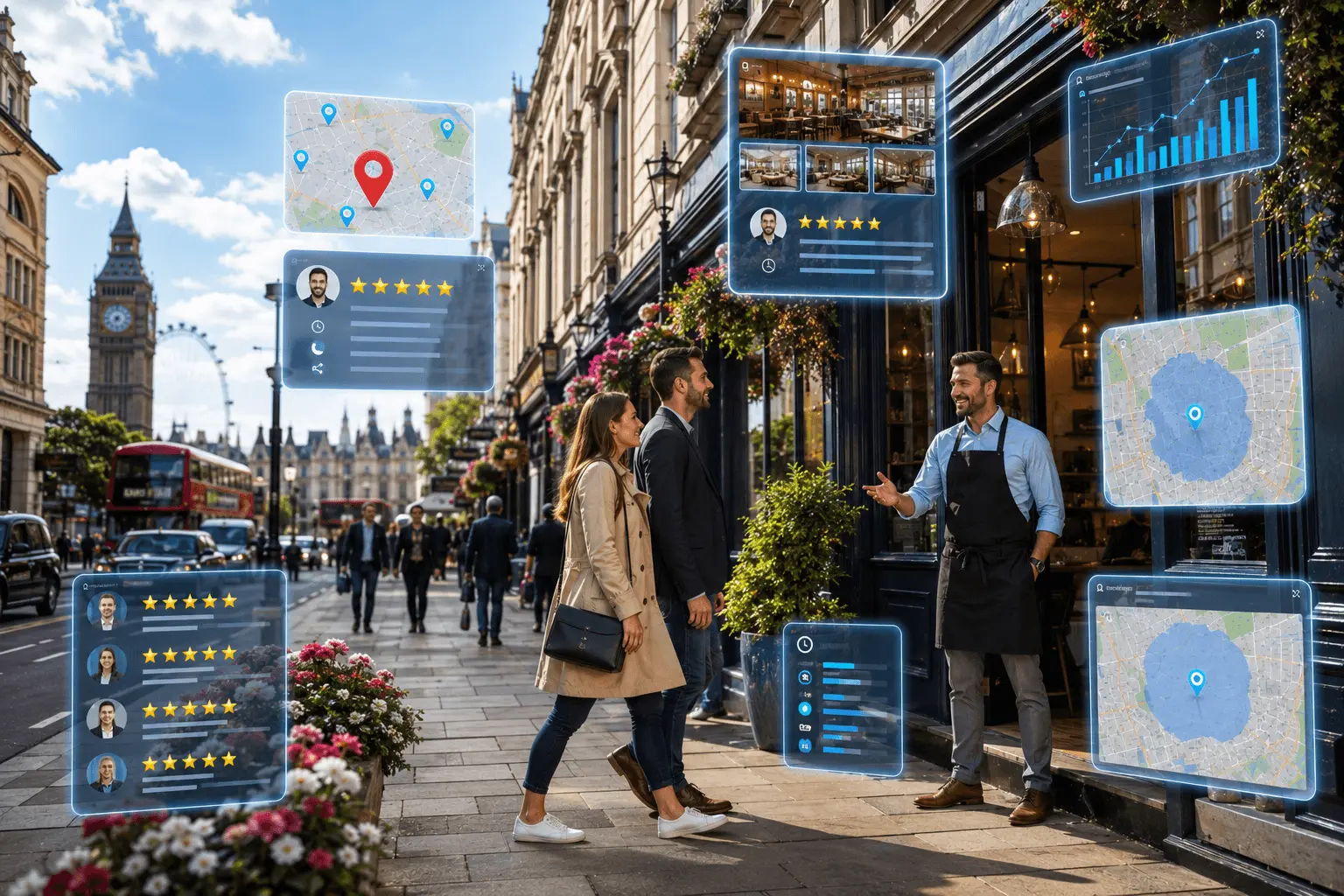
When Omar opened his second physiotherapy clinic in Shoreditch two years ago, he expected the same steady flow of new patients his original Hackney location had built over four years. Same quality of care, similar demographic area, comparable foot traffic on the high street outside. What he did not expect was that his new clinic would sit invisible on Google Maps for the first six months while a competing practice three streets away, which had been open for less than a year, consistently appeared in the top two Local Pack positions for every relevant search.
His Hackney clinic ranked well because it had four years of accumulated reviews, a claimed and optimised Google Business Profile, and a citation footprint that had been built gradually over time. His Shoreditch clinic had none of that history and, critically, he had not treated its Google Business Profile as a priority in the busy months surrounding the opening.
Omar called me after a patient mentioned they had almost not found the Shoreditch clinic because it did not appear when they searched for physiotherapy in the area. That conversation prompted an audit that revealed a claimed but almost completely empty Google Business Profile, zero reviews, an incomplete services section, three photos, and a business description that had been copied word for word from the Hackney listing without any Shoreditch-specific content.
If you want expert help with this, explore our Google Business Profile Optimisation — we work with service businesses across the UK, Dubai, and UAE.
You may also find these guides useful: How to Rank on Google Maps: Step-by-Step Guide, GMB Optimization Dubai: Dominate Google Maps.
London is the most competitive local search environment in the UK. In virtually every service category and every London borough, there are more businesses competing for the same Local Pack positions than in any other city in the country. A Google Business Profile that would rank comfortably in Sheffield or Bristol needs significantly more depth, more activity, and more precision to compete in Islington, Clapham, or Canary Wharf. This guide gives you the complete optimisation framework for standing out in London's uniquely challenging local search landscape.
Why London Local Search Is Different From Every Other UK Market
The fundamental challenge of Google Business Profile optimisation in London is density. In most UK cities, a business in a given category might compete against 10 to 20 other listings for Local Pack visibility. In London, the same category in a single postcode district might have 40 to 80 competing listings. Google has three positions to fill in the Local Pack and in London those three positions are being fought over by more businesses per square mile than anywhere else in the country.
That density creates two specific challenges that London businesses face and businesses in other UK cities largely do not. First, the minimum standard of profile quality required to rank is significantly higher because your profile is competing against businesses that have been optimising aggressively for years in one of the most commercially valuable search markets in Europe. A profile that would rank in the top three in a mid-size UK city might not make the top ten in its equivalent London borough.
Second, proximity weighting in London's local search results is more granular than in less dense areas. Because so many businesses are geographically close to searchers, Google's distance calculations produce fine distinctions between businesses that are a few hundred metres apart rather than a few kilometres. A business in Dalston competing for searches in Shoreditch is competing at a proximity disadvantage against businesses physically located in Shoreditch, even though the distance is less than a mile.
The implication is that London businesses need to approach Google Business Profile optimisation with more precision, more consistency, and more ongoing activity than they would in any other UK market. The baseline that gets you visible in other UK cities is not the baseline that gets you competitive in London.
1Step 1: Claim and Complete Your Profile With London-Specific Precision
If your Google Business Profile is unclaimed, go to business.google.com today and complete the verification process before any other optimisation work. London businesses can typically verify by postcard within three to five days or, in some cases, immediately by phone or video verification.
Category selection in London requires more precision than in less competitive markets because the volume of competing businesses means that a broad category selection puts you in direct competition with the maximum number of other listings. Your primary category should be the most specific option Google offers for your core service. A physiotherapy clinic should select "Physiotherapist" rather than "Health Clinic." A conveyancing solicitor should select "Conveyancer" rather than "Solicitor." A Thai restaurant should select "Thai Restaurant" rather than "Restaurant." In London's competitive environment, category precision is a meaningful ranking differentiator rather than a minor technical detail.
Add every applicable secondary category for services your business provides beyond its primary focus. Each secondary category expands the searches for which your listing can appear, and in London where search volume across all local queries is high, every additional relevant category represents genuine commercial opportunity.
Your business description is where most London businesses underperform significantly. The 750 characters available to you should include your primary service area within London at the neighbourhood or borough level, your core services described in the language your customers use when searching rather than industry terminology, any distinctive credentials or specialisations that differentiate you from the dozens of competitors in your category, and a clear statement of who you serve and how to reach you. A physiotherapy clinic in Shoreditch should mention Shoreditch, Hackney, and Bethnal Green explicitly. A cleaning company in South London should mention Clapham, Brixton, and Balham. Geographic specificity in your description contributes to the relevance signals Google uses to match your listing to location-specific searches.
Complete every available section of your profile without exception. Hours including any extended or weekend availability. Special hours for bank holidays and London-specific seasonal variations. Your website URL. Your phone number. The services section with individual entries for each service you provide. The products section if applicable. Appointment booking links if your business takes bookings. Accessibility information. Each completed section is a data point that Google uses to evaluate and rank your listing. In London's competitive environment, incomplete profiles rarely appear in the top three regardless of how strong their other signals are.
2Step 2: Upload Photos That Show Your London Presence and Build Visual Trust
London customers searching for local services are evaluating your listing visually before they make contact. In a city where a typical Local Pack search returns three well-presented businesses with substantial photo libraries, a profile with five or six generic photos loses the visual comparison immediately regardless of its other signals.
Upload a minimum of 30 photos and treat your photo library as a living asset that grows over time rather than a one-time upload. The photo types that perform best in London's local search environment include exterior shots that show your location on the street clearly, which helps customers identify your premises in London's often complex navigation environment. Interior photos that convey the environment customers will experience. Team photos that show the people behind the business because London customers are often choosing between businesses with comparable credentials and a human connection can be the deciding factor. Before and after project photos for trade businesses. Food photos for hospitality businesses taken in good light that shows the actual product rather than styled marketing images that look nothing like what customers receive.
Include at least two to three photos that specifically reference your London location or neighbourhood. A photo of your premises with a recognisable London street or landmark in the background, a photo showing your team at a London industry event, or an image that visually connects your business to its specific London context all contribute to the geographic authenticity that strengthens your local relevance signals.
Update your photo library at least monthly. Google's algorithm gives additional visibility to profiles that demonstrate consistent activity and photo uploads are one of the clearest activity signals available. A profile with 40 photos uploaded over 18 months signals consistent engagement. A profile with 40 photos uploaded in a single day signals a one-time effort that was not maintained.
3Step 3: Build a London Review System That Generates Consistent Volume
Review volume and velocity carry more ranking weight in London than in most other UK markets because the sheer density of competition means that review count often becomes a tiebreaker between businesses with similarly optimised profiles. A business with 120 reviews averaging 4.7 stars will almost always outrank a business with 35 reviews averaging 4.9 stars in London's Local Pack, all other signals being approximately equal.
The challenge London businesses face with reviews is that their customer base is often more transient and more diverse than businesses in smaller cities. London customers move frequently, come from varied cultural backgrounds where review-leaving behaviour differs, and are often simply busier than customers in less demanding urban environments. These factors make passive review accumulation slower in London than elsewhere and make systematic review generation more necessary.
Build a review request into every completed transaction or service interaction. For service businesses, a post-appointment text with a direct link to your Google review page sent within two hours of the customer leaving produces significantly higher response rates than a request sent the following day. For retail or hospitality businesses, a polite in-person ask supported by a QR code at the point of payment removes the friction of finding your listing independently. For professional services, a follow-up email after a completed matter or project with a direct review link and a brief explanation of how much reviews help a small London business reach new clients converts at a meaningful rate with satisfied clients.
When Omar implemented a systematic post-appointment review request for his Shoreditch clinic using a simple automation in his booking software, his review count grew from zero to 54 within three months of opening. That volume, combined with his completed profile optimisation, moved his listing from invisible to position two in the Local Pack for physiotherapy searches in Shoreditch. His review velocity, two to three new reviews per week, has kept him in that position without additional intervention.
Respond to every review your London listing receives within 24 hours wherever possible. London customers reading your review responses are evaluating whether your business treats feedback seriously and whether the voice behind the responses feels like a real, engaged business owner. Generic templated responses are immediately recognisable and fail to convey the authenticity that London's discerning customer base responds to.
4Step 4: Optimise for London's Neighbourhood-Level Search Behaviour
Londoners search for local services at a neighbourhood and postcode level to a degree that customers in smaller UK cities rarely do. A customer in Manchester might search for "personal trainer Manchester." A customer in London is far more likely to search for "personal trainer Clapham" or "personal trainer near Clapham Common." This neighbourhood-level search behaviour creates specific optimisation requirements that businesses in other UK cities do not face.
Your Google Business Profile's service area settings should list every London borough, neighbourhood, and postcode district where you actively serve customers. Do not limit your service area to your immediate vicinity if you genuinely operate across a wider London area. A plumber based in Wandsworth who serves customers across South London should list Wandsworth, Battersea, Clapham, Stockwell, Streatham, and Tooting as service areas rather than just their immediate postcode.
Your website needs to support your profile's geographic claims with dedicated location pages for each London area you serve. A cleaning company with a Hammersmith base that serves customers across West London should have individual pages for Hammersmith, Chiswick, Ealing, Acton, and Shepherd's Bush at a minimum. Each page should include the neighbourhood name naturally throughout its content, reference any local characteristics relevant to the service in that area, and contain genuinely unique content rather than templated copy with the neighbourhood name swapped in.
The Q and A section of your Google Business Profile is an underused opportunity to address London-specific customer concerns. Add questions and answers that speak directly to London context. For a removal company, questions like "Do you cover congestion charge zones?" and "Can you handle parking permit areas in Central London?" address real customer concerns specific to London operations. For a food delivery or catering business, "Which London postcodes do you cover?" is a natural Q and A entry. These locally specific answers contribute to your relevance for London-specific searches and reduce friction for potential customers evaluating your listing.
5Step 5: Use Google Posts to Stay Visible in London's High-Activity Search Environment
In London's competitive Local Pack, profile activity signals carry more ranking weight than in smaller markets because the baseline level of competitor activity is higher. A business that posts updates twice monthly is competing against London businesses posting multiple times per week in some categories. The minimum posting frequency that maintains competitive ranking visibility in London is higher than the general guidance of twice per month that applies in less competitive UK markets.
Aim for at least one Google Post per week in London. The content of your posts should reflect the London context of your business wherever possible. A restaurant in Soho should reference upcoming London Food Month events or local neighbourhood festivals. A fitness studio in Notting Hill should post about Bank Holiday availability specific to London's schedule. A legal firm in the City should post about regulatory changes affecting London's business community. Locally specific post content signals to Google that your business is actively embedded in its London neighbourhood rather than operating as a generic national business with a London address.
Seasonal content tied to London's specific calendar generates higher engagement than generic seasonal posts. The London Marathon in April, Notting Hill Carnival in August, the various borough-specific events throughout the year, and London Fashion Week all create content hooks that resonate with London-based searchers in ways that general seasonal content does not. Higher engagement with your posts contributes to the behavioural signals Google uses to evaluate your listing's relevance and activity.
6Step 6: Build a London Citation Footprint That Reinforces Your Geographic Authority
Your citation profile for a London business needs to include both the national high-authority directories that matter for all UK businesses and the London-specific sources that send geographic specificity signals no national directory can replicate.
Beyond the standard national directories including Yelp, Yell, the Better Business Bureau, and Bing Places, London businesses should prioritise citations on sources specific to their borough or area. Most London borough councils maintain local business directories. The London Chamber of Commerce member directory carries strong geographic authority. Time Out London's business listings, the Evening Standard's business directory, and various London-specific neighbourhood websites like Brixton Buzz, Hackney Citizen, or Wandsworth Guardian all represent citation opportunities with genuine London geographic relevance.
Industry associations with London chapters or London-specific directories provide the combination of topical and geographic relevance that national industry directories alone cannot deliver. A London-based architect should appear in the RIBA London chapter's directory. A London restaurant should claim its Michelin Guide listing if applicable and its Square Meal profile. A London-based financial adviser should appear in the Personal Finance Society's London member directory.
Ensure every citation uses exactly the same NAP format with particular attention to your London address. London addresses are often complex with building names, floor numbers, and multiple postcode variations and inconsistencies in how different listings record these details are common. Standardise your address format including whether you include the London borough in your address line, whether you abbreviate Street to St, and exactly how your postcode is formatted, and apply that standard without variation across every citation.
Common Google Business Profile Mistakes London Businesses Make
Adding the word London or a London neighbourhood to your business name in your Google Business Profile to appear more locally relevant is a policy violation that can get your listing suspended. Your profile name must match your real, legal trading name exactly. Geographic keywords in your business name are one of the most common reasons London listings are reported to Google for spam and subsequently removed from the Local Pack.
Optimising your Google Business Profile once and then not returning to it for months is a strategy that may work in smaller UK cities but will consistently lose ranking in London to competitors who maintain regular activity. In London's competitive environment, profile dormancy is visible in relative terms even when your absolute optimisation is strong.
Targeting the broadest possible geographic area in your service area settings without the website content to support those claims creates a credibility gap that Google's algorithm recognises. If your service area lists 20 London boroughs but your website has no location-specific content for any of them, the service area claim is unsupported by the on-site signals Google expects to see alongside it.
Ignoring the Q and A section leaves visible gaps on your listing that competitors who have populated theirs will exploit. In London where potential customers are often comparing multiple listings side by side before making contact, a profile with substantive Q and A content presents as more established and more prepared than one that leaves basic questions unanswered.
Frequently Asked Questions
In London's competitive environment, the timeline is longer than most other UK markets. For moderate-competition categories in outer London boroughs, meaningful ranking improvement typically appears within 60 to 90 days of completing a full profile optimisation combined with systematic review generation. For highly competitive categories in Central London boroughs like Westminster, the City, and Kensington and Chelsea, reaching the top three can take six to twelve months of sustained optimisation effort. New profiles without any review history should expect to spend the first two to three months building foundational signals before significant ranking movement becomes visible.
Yes, each genuine physical location should have its own separate Google Business Profile with unique content, photos, and a location-specific review profile. Omar's Hackney and Shoreditch clinics are a good example of this done correctly. Each profile should have its own description written specifically for its neighbourhood, its own photo library showing that specific location, and its own review generation system so that reviews accumulate independently for each site. Do not copy content between location profiles as Google treats this as thin or duplicate content and it reduces the distinctiveness of each listing.
Yes, particularly for high-value service categories like trades, legal services, financial advice, and home improvement where lead values justify the pay-per-lead cost. London search volumes are high enough that Local Services Ads produce meaningful lead volume for qualified businesses and the Google Guarantee badge included with approved listings carries strong trust signals with London's often cautious urban consumers. Run Local Services Ads as a complement to organic profile optimisation rather than a replacement, and review cost-per-lead monthly to ensure the economics remain positive as organic rankings develop.
Google does not explicitly weight reviews by reviewer location in its ranking signals. However, reviews from customers who mention London neighbourhoods, specific London landmarks, or London-specific context in their review text contribute to the semantic profile of your listing in ways that generic reviews do not. Encouraging satisfied London customers to write detailed reviews that naturally include geographic context, without coaching them on what to write, produces review content that strengthens your listing's relevance for London-specific searches over time.
Yes, but the strength of your ranking will always be strongest in the immediate vicinity of your verified business address and will diminish with distance. A business in Hackney will rank most strongly for searches in Hackney and neighbouring areas like Islington and Stoke Newington, and progressively less strongly for searches in boroughs further away. Building website location pages for each borough you serve, earning local backlinks from borough-specific sources, and accumulating reviews from customers across those areas all extend your effective ranking radius over time, but proximity to the searcher remains Google's most heavily weighted local ranking signal regardless of how strong your other optimisation is.
Winning London's Most Competitive Local Search Market
Omar's Shoreditch clinic today sits at position one in the Local Pack for physiotherapy searches in the area. It took four months of consistent, focused work to get there from a standing start. That work included completing every section of his Google Business Profile with Shoreditch-specific content, building a weekly post schedule that referenced local neighbourhood events and seasonal health topics, implementing the post-appointment review request system that generated 54 reviews in three months, adding 35 new photos including team shots and location-specific images, and building citations on Hackney Council's business directory and three Shoreditch-specific local platforms alongside the standard national directories.
None of those individual actions was complicated. All of them required consistency and attention to the specific demands of London's local search environment rather than the generic optimisation advice that applies in less competitive UK markets.
The London businesses sitting at the top of the Local Pack in your category and your borough are not using secret tactics or spending enormous budgets. They are doing the fundamentals better than their competitors, maintaining consistent activity, and treating their Google Business Profile as the most valuable marketing asset their business owns. In London's search environment, that combination of precision and consistency is what separates the businesses customers find from the businesses customers never discover.
Which London borough or neighbourhood does your business serve and what do you think is the biggest gap in your current Google Business Profile? Share it in the comments and let's work through a specific action plan for your local market.
Want Results Like This for Your Business?
Get a free Local SEO audit — we will show you exactly what is holding your rankings back and the fastest path to the Google map pack.
Talk to a Local SEO Specialist →